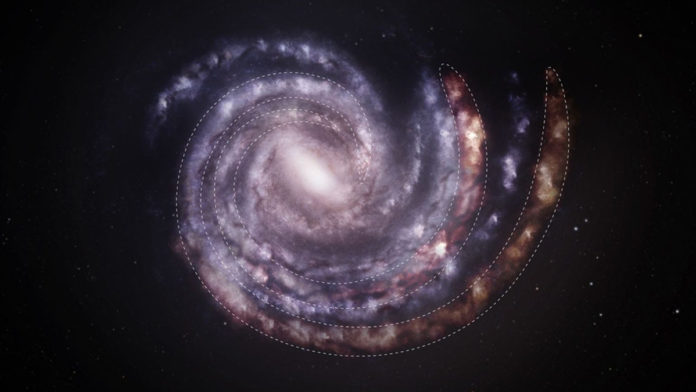
A team of astronomers has identified that the spiral arms of the Milky Way galaxy may extend farther into space than previously understood. This significant finding, derived from precise distance measurements of dust clouds within these arms, underscores the complexity of our galaxy’s structure.
Utilising data from NASA’s Chandra X-ray Observatory and the European Space Agency’s XMM-Newton, researchers employed powerful gamma-ray bursts detectable in distant galaxies. As X-rays from these bursts traversed the Milky Way, some light reflected off dust clouds, allowing for accurate ring measurements. Beatrice Vaia, leading the study, remarked that this method relies solely on geometry, drawing a contrast to alternative methods that depend on uncertain assumptions about the galaxy’s rotation.
The data collected indicated that the dust cloud in the most distant arm of the Milky Way measures approximately 3,500 light-years in width. Historically, mapping the Milky Way has proved challenging due to Earth’s internal position within one of its arms.
The recent advancement in observing gamma-ray bursts, unhindered by Earth’s location, holds the potential to fundamentally alter our understanding of the Milky Way. Ilaria Fornasiero, a co-author on the study, indicated that even minor revisions to distance estimates could necessitate recalibrations of the galaxy’s mass, consequently influencing the perceived width of its spiral arms.
Despite its promise, this technique faces limitations due to the rarity of suitable gamma-ray bursts. In the last 25 years, researchers have encountered only a few bright enough to facilitate these measurements. Co-author Andrea Tiengo confirmed the team’s intention to seek out more such bursts in future endeavours.