Monday, June 15, 2026

Transforming a Scanning Electron Microscope into a TEM

Although both a scanning electron microscope (SEM) and a transmission electron microscope (TEM) utilise electrons, their operational principles and resulting images differ significantly. An SEM generates images by using secondary electrons ejected after a sample’s surface is bombarded with primary electrons. In contrast, a TEM resembles an X-ray machine, using a sensor positioned behind the sample to detect primary electrons after they have traversed the sample. Notably, it is feasible to convert an SEM into a TEM with some ingenuity, as demonstrated in a recent project by ProjectsInFlight.

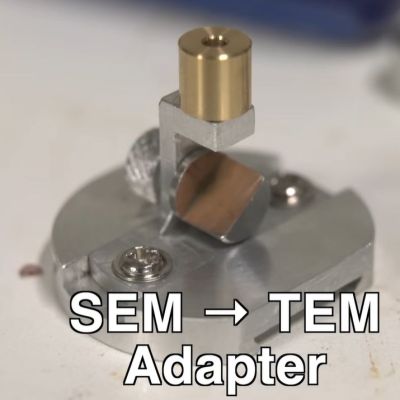
Previously, coverage highlighted how the SEM, initially slated for disposal, was revitalised and is now undergoing a notable enhancement. This transformation from SEM to TEM, termed scanning transmission electron microscopy (STEM), is not a novel phenomenon; it has been achievable for some time using a relatively straightforward reflecting adapter. However, these adapters often carry a hefty price tag that may deter potential buyers, yet they are sufficiently simple that some might opt to construct one independently.

The primary challenge in creating a DIY adapter lies in maintaining appropriate clearance between the sample holder and the delicate internal components of the chamber. This clearance measures just under 14 mm (0.55 inches), which restricts available space, though using a streamlined aluminium sample plate significantly increased the available room for essential elements such as the primary electron mirror.

After completing extensive machining processes, the sample holder was fully assembled. During evaluations, a modification allowed for adjusting the mirror angle within the evacuated vacuum chamber, optimising the adapter’s performance. Initial tests featured gold nanoparticles, which highlighted a deficiency in the secondary electron shield.

Subsequent experiments indicated that the shield required a higher extension for effective blockage of secondary electrons, resulting in a marked improvement in TEM imagery. A mosquito, preserved and no longer viable, provided wings for analysis, revealing intricate structures through TEM imaging.

The next objective involves TEM imaging of biological cells, which necessitates thorough preparation.

Test Your Understanding

Start Quiz

Vocabulary List:
6 words · tap to reveal
ON

Accent

secondary/ˈsɛkəndɛri/adjective
coming after the first; not the main one

traversed/trəˈvɜrst/verb
moved across or through an area or space

adapter/əˈdæptɚ/noun
a device that joins or changes equipment

clearance/ˈklɪrəns/noun
the empty space needed to allow movement

evacuated/ɪˈvækjueɪtɪd/adjective
emptied of air or people; made space empty

intricate/ˈɪntrɪkət/adjective
very detailed and made of many small parts

How much do you know?

What does an SEM generate images from?
Primary electrons
Secondary electrons
X-rays
Optical light
What is the purpose of the sensor in a TEM?
To ejected secondary electrons
To detect primary electrons
To modify the sample
To produce secondary images
What is the term for converting an SEM into a TEM?
Electron scanning
Scanning transmission electron microscopy (STEM)
Optical enhancement
Microscopic adaptation
What is a significant challenge in creating a DIY adapter for an SEM?
Cost of materials
Maintaining appropriate clearance
Finding suitable samples
Complex construction
What enhancement was made to the adapter during evaluations?
Increased power
Mirror angle adjustment
New sensor technology
Additional parts
What biological subject was used for analysis in the experiments?
Bacteria
Viruses
Mosquito wings
Animal cells
An SEM and a TEM operate on the same principles.
It is complicated to convert an SEM into a TEM.
The clearance required for the adapter is more than 14 mm.
Initial tests showed sufficient effectiveness of the secondary electron shield.
The adapter's performance improved after adjustments were made.
The next objective is TEM imaging of geological samples.
An SEM generates images by using secondary electrons ejected after a sample's surface is bombarded with primary electrons in .
The clearance measures just under 14 mm (0.55 inches), which restricts available space, though using a streamlined aluminium sample plate significantly increased the available room for .
The primary electron mirror was adjusted to optimize the adapter's .
Subsequent experiments indicated that the shield required a higher extension for effective of secondary electrons.
A mosquito, preserved and no longer viable, provided for analysis.
The next objective involves TEM imaging of biological cells, which necessitates thorough .
This question is required

Test Your Understanding

Start Quiz
Vocabulary List:
6 words · tap to reveal
ON
Accent
secondary/ˈsɛkəndɛri/adjective
coming after the first; not the main one
traversed/trəˈvɜrst/verb
moved across or through an area or space
adapter/əˈdæptɚ/noun
a device that joins or changes equipment
clearance/ˈklɪrəns/noun
the empty space needed to allow movement
evacuated/ɪˈvækjueɪtɪd/adjective
emptied of air or people; made space empty
intricate/ˈɪntrɪkət/adjective
very detailed and made of many small parts

How much do you know?

What does an SEM generate images from?
Primary electrons
Secondary electrons
X-rays
Optical light
What is the purpose of the sensor in a TEM?
To ejected secondary electrons
To detect primary electrons
To modify the sample
To produce secondary images
What is the term for converting an SEM into a TEM?
Electron scanning
Scanning transmission electron microscopy (STEM)
Optical enhancement
Microscopic adaptation
What is a significant challenge in creating a DIY adapter for an SEM?
Cost of materials
Maintaining appropriate clearance
Finding suitable samples
Complex construction
What enhancement was made to the adapter during evaluations?
Increased power
Mirror angle adjustment
New sensor technology
Additional parts
What biological subject was used for analysis in the experiments?
Bacteria
Viruses
Mosquito wings
Animal cells
An SEM and a TEM operate on the same principles.
It is complicated to convert an SEM into a TEM.
The clearance required for the adapter is more than 14 mm.
Initial tests showed sufficient effectiveness of the secondary electron shield.
The adapter's performance improved after adjustments were made.
The next objective is TEM imaging of geological samples.
An SEM generates images by using secondary electrons ejected after a sample's surface is bombarded with primary electrons in .
The clearance measures just under 14 mm (0.55 inches), which restricts available space, though using a streamlined aluminium sample plate significantly increased the available room for .
The primary electron mirror was adjusted to optimize the adapter's .
Subsequent experiments indicated that the shield required a higher extension for effective of secondary electrons.
A mosquito, preserved and no longer viable, provided for analysis.
The next objective involves TEM imaging of biological cells, which necessitates thorough .
This question is required

Read More