Tuesday, July 28, 2026

Loud Noises Disrupt Southern New England Quiet

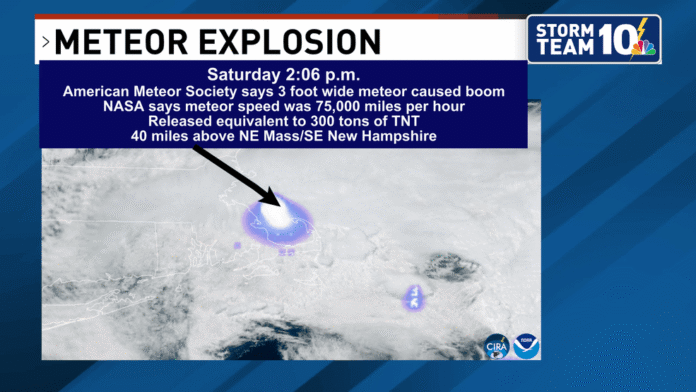
A meteor about 3 feet wide entered Earth’s atmosphere near the Massachusetts/New Hampshire state line on Saturday afternoon, causing a loud boom. The American Meteor Society reports that it is unlikely the meteor hit the ground, as it broke apart before reaching the surface.

NASA confirmed the sighting of a fireball meteor at 2:06 p.m. EDT. It travelled at approximately 75,000 mph and exploded at an altitude of 40 miles above northeast Massachusetts and southeast New Hampshire. This fireball is not linked to any active meteor shower; it was a natural object and not space debris. The explosion released energy similar to 300 tons of TNT, which created the loud noise heard across the region.

Local residents reported their houses shaking after the boom. The NOAA’s GOES satellite detected a significant flash in Massachusetts Bay, likely caused by the meteor’s explosion.

Most meteors are usually tiny, like grains of sand, and are often silent during meteor showers. However, this meteor was much larger. A meteor becomes a meteorite if it strikes the Earth’s surface, but it seems this one disintegrated in the atmosphere without making contact.


Test Your Understanding

Start Quiz

Vocabulary List:
6 words · tap to reveal
ON

Accent

meteor/ˈmitiɔr/noun
a space rock that enters Earth's air

atmosphere/ˈætməsfɪr/noun
the layer of air around the planet

fireball/ˈfaɪərbɔl/noun
a very bright, fast-burning object in the sky

altitude/ˈæltəˌtuːd/noun
height above the ground or sea level

debris/dəˈbriː/noun
pieces of broken material or waste

disintegrated/dɪsˈɪntəˌɡreɪtɪd/verb
broke apart into many small pieces

How much do you know?

How wide was the meteor that entered Earth's atmosphere near the Massachusetts/New Hampshire state line?
1 foot
3 feet
5 feet
10 feet
At what speed did the meteor travel?
10,000 mph
30,000 mph
75,000 mph
100,000 mph
What altitude did the meteor explode at?
20 miles
30 miles
40 miles
50 miles
How much energy did the explosion of the meteor release?
100 tons of TNT
200 tons of TNT
300 tons of TNT
400 tons of TNT
What satellite detected the significant flash in Massachusetts Bay?
Landsat
Hubble
NOAA's GOES satellite
Terra
Was the fireball meteor linked to any active meteor shower?
Yes
No
Only during the day
Only during the night
The meteor hit the ground after entering the atmosphere.
The explosion of the meteor created a loud noise heard across the region.
Most meteors are generally large and noisy.
A meteor becomes a meteorite if it strikes the Earth's surface.
NASA confirmed the sighting of the meteor at 2:06 p.m. EDT.
The meteor disintegrated in the atmosphere without striking the Earth's surface.
The meteor caused a loud boom and was about wide.
NASA confirmed the fireball meteor at p.m. EDT.
The meteor travelled at approximately mph.
The explosion released energy similar to tons of TNT.
A meteor becomes a meteorite if it the Earth's surface.
Local residents reported their houses shaking after the .
This question is required

Test Your Understanding

Start Quiz
Vocabulary List:
6 words · tap to reveal
ON
Accent
meteor/ˈmitiɔr/noun
a space rock that enters Earth's air
atmosphere/ˈætməsfɪr/noun
the layer of air around the planet
fireball/ˈfaɪərbɔl/noun
a very bright, fast-burning object in the sky
altitude/ˈæltəˌtuːd/noun
height above the ground or sea level
debris/dəˈbriː/noun
pieces of broken material or waste
disintegrated/dɪsˈɪntəˌɡreɪtɪd/verb
broke apart into many small pieces

How much do you know?

How wide was the meteor that entered Earth's atmosphere near the Massachusetts/New Hampshire state line?
1 foot
3 feet
5 feet
10 feet
At what speed did the meteor travel?
10,000 mph
30,000 mph
75,000 mph
100,000 mph
What altitude did the meteor explode at?
20 miles
30 miles
40 miles
50 miles
How much energy did the explosion of the meteor release?
100 tons of TNT
200 tons of TNT
300 tons of TNT
400 tons of TNT
What satellite detected the significant flash in Massachusetts Bay?
Landsat
Hubble
NOAA's GOES satellite
Terra
Was the fireball meteor linked to any active meteor shower?
Yes
No
Only during the day
Only during the night
The meteor hit the ground after entering the atmosphere.
The explosion of the meteor created a loud noise heard across the region.
Most meteors are generally large and noisy.
A meteor becomes a meteorite if it strikes the Earth's surface.
NASA confirmed the sighting of the meteor at 2:06 p.m. EDT.
The meteor disintegrated in the atmosphere without striking the Earth's surface.
The meteor caused a loud boom and was about wide.
NASA confirmed the fireball meteor at p.m. EDT.
The meteor travelled at approximately mph.
The explosion released energy similar to tons of TNT.
A meteor becomes a meteorite if it the Earth's surface.
Local residents reported their houses shaking after the .
This question is required

Read More