Warning: foreach() argument must be of type array|object, false given in /home/u750883576/domains/esl-news.com/public_html/wp-content/plugins/gpt-post-quiz/includes/admin/class-gpoq-admin-4.php on line 450
Warning: foreach() argument must be of type array|object, false given in /home/u750883576/domains/esl-news.com/public_html/wp-content/plugins/td-composer/legacy/common/wp_booster/td_menu.php on line 88
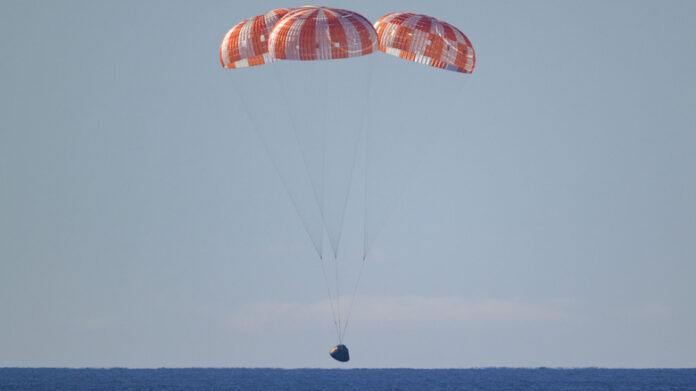
On April 10, NASA’s Artemis II mission saw the Orion spacecraft safely splash down off the coast of San Diego. However, it did not land directly on land, which would have been preferable. Ocean landings present challenges, like dealing with large waves and the need for U.S. Navy vessels to retrieve astronauts by helicopter. A land landing would be easier, allowing for quicker transport by truck. However, NASA’s technical choices meant that ocean splashdowns were necessary, despite their complexity.
Returning spacecraft come back to Earth at very high speeds. The Orion spacecraft, for example, reached Mach 35. Using parachutes alone slows the craft down only so much, and it still hit the water at 20 mph. Thus, NASA has opted for ocean landings to cushion the return.
The Russian spacecraft Soyuz, on the other hand, lands on solid ground using a different method. After using parachutes, it fires retrorockets just before touchdown to reduce speed to around 3 mph.
Although this Russian method has its benefits, it also has drawbacks, such as limited crew capacity. NASA and companies like Boeing are now exploring new technologies to improve land landings. Boeing’s Starliner plans to use inflatable bags for a softer landing, enhancing safety and retrieval efficiency. In September 2024, a Starliner successfully landed in New Mexico, marking progress in this area.