

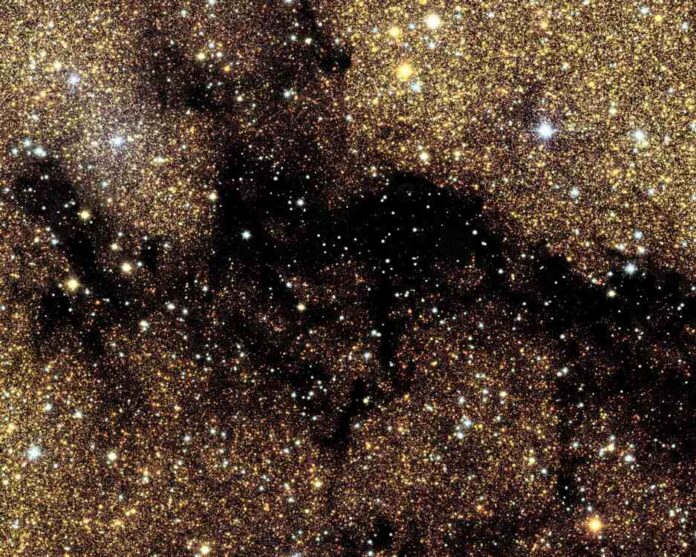
A new space telescope has successfully captured images of millions of stars at the centre of the Milky Way galaxy. The European Space Agency (ESA)’s Euclid Telescope, positioned one million miles from Earth, spent 26 hours photographing this densely packed region of the galaxy.
In just one snapshot, the telescope revealed around 60 million stars. However, its main goal is not to study the stars themselves but to search for the planets that likely orbit them. Dr. Eamonn Kerins, an astrophysicist from the University of Manchester, highlighted that Euclid was not originally designed for this purpose but offers a valuable opportunity for exoplanet research—the study of planets outside our solar system.
This breakthrough could lead to the discovery of more than 100,000 exoplanets, a significant increase from the current total of about 6,000. Dr. Kerins also pointed out that while the telescope was built to explore dark matter and dark energy, it has turned out to be an excellent tool for detecting exoplanets using the microlensing method. This technique involves observing how the gravity of a foreground star can bend light from a more distant star, making it appear brighter when an orbiting planet passes closely.
Euclid’s data is expected to assist in pinpointing the locations of thousands of exoplanets for further study. Launched in 2024, the telescope represents a key development in our understanding of the universe.


