

To understand aging better, we need to look at what happens in our cells. Over time, cells become less efficient and prone to diseases. A study from Germany’s Fritz Lipmann Institute has new insights on how mitochondria — the cell’s energy producers — slow down with age.
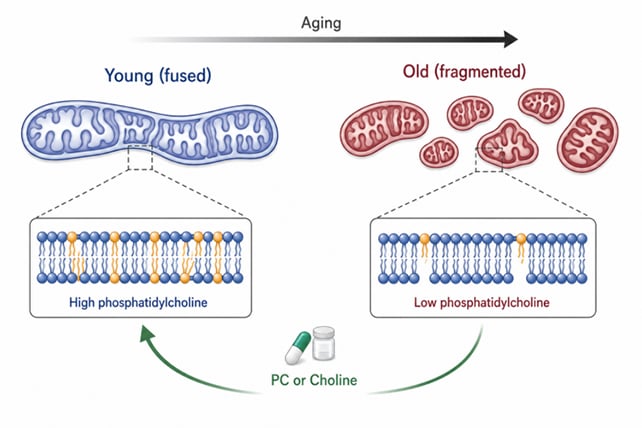
Researchers studied worms, human tissue, and cells, finding that a lipid (a type of fat) called phosphatidylcholine decreases as we age. They discovered that restoring it through diet can rejuvenate mitochondria.
Phosphatidylcholine helps keep mitochondrial membranes healthy. When supplies decrease, mitochondria do not function well. By adding phosphatidylcholine or choline (which turns into phosphatidylcholine) to the diet of worms, mitochondria regained their youthful flexibility.
The research showed that low levels of phosphatidylcholine are common in people with diabetes or obesity. Higher levels were linked to better memory and faster walking, signs of healthy aging. Older worms showed a decrease in phosphatidylcholine due to reduced production of proteins that create it.
Mitochondria usually form flexible chains to manage energy. With age and less phosphatidylcholine, they become less efficient. In human data, the lipid’s decline is steeper in women, especially around menopause.
The findings suggest that improving phosphatidylcholine levels could slow mitochondrial aging. Researchers aim to explore its impact on mitochondrial membranes further. Although humans are more complex than worms, these insights offer hope for managing aging.
The study is published in Nature Communications.


