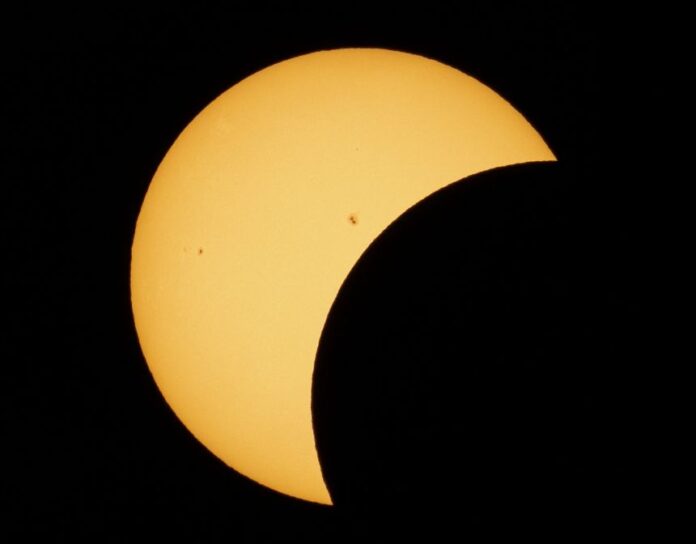
On August 12, a total solar eclipse will occur, providing a rare astronomical event visible from parts of Greenland, Iceland, northern Spain, and northeastern Portugal. This phenomenon is significant as it marks the first such eclipse observable from Spain’s mainland since 1905.
A total solar eclipse occurs when the moon moves directly between the sun and Earth, casting a shadow that obscures the sun’s light in certain areas. Observers in the path of totality will experience a momentary darkness as the sun disappears completely, while regions outside this path will witness a partial eclipse, where only a portion of the sun’s light is blocked.
This eclipse follows one seen in parts of Mexico, the United States, and Canada in April 2024. The last total solar eclipse in mainland Europe transpired in 2006. The upcoming event is particularly notable for Spain, where it is the first of three solar eclipses anticipated by 2028.
Carole Mundell, director of science at the European Space Agency (ESA), expressed that such eclipses unite people in shared awe and curiosity about the universe. The path of totality will cover 5,157 miles (8,300 kilometers), beginning over the Arctic coast and traversing Greenland, Iceland, Portugal, and northern Spain.
Conditions permitting, viewers in Greenland could witness over two minutes of totality, while those in northern Spain may see around 20 seconds. With inclement weather being a significant challenge for eclipse viewing, enthusiasts are encouraged to keep an eye on forecasts.
People outside the eclipse’s path can still engage through a livestream of totality provided by the ESA from the Astrophysical Observatory of Javalambre in Teruel, Spain. Following this event, another total solar eclipse will take place on August 2, 2027, passing over southern Spain and parts of North Africa.
Test Your Understanding
How much do you know?