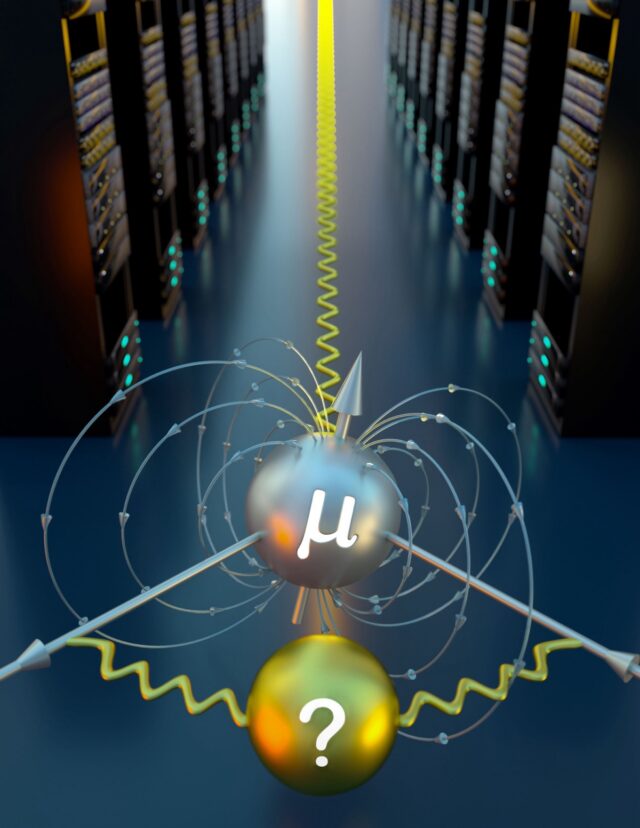
This latest measurement examines the effects of the strong nuclear force, particularly a phenomenon known as “hadronic vacuum polarization.” This effect occurs as quarks and gluons—fundamental particles—interact, guided by quantum chromodynamics (QCD) theory. The researchers employed a hybrid method, merging advanced large-scale computer simulations with empirical data.
According to Fodor, a key figure in the research, the previous methodology required gathering numerous experimental results and reinterpretation to arrive at a single figure for the muon’s magnetic moment. In contrast, their approach involved dividing space-time into minute cells, forming a lattice, and resolving the equations of the Standard Model of particle physics on this structure. This process necessitated extensive theoretical, mathematical, programming, and computational expertise.
After a decade of complex calculations, their findings aligned with the Standard Model to within half a standard deviation, achieving accuracy down to eleven decimal places. This calculation represents the highest precision attained yet, with an accuracy measured in parts per billion. While the results do not completely dismiss the possibility of new phenomena, such as a hypothetical fifth force, they significantly limit the potential areas where such physics might exist.
Fodor expressed a sense of ambivalence regarding the discovery. Initially, the expectation was to identify credible evidence for a new fifth force. However, the results indicated no such force exists, providing instead a precise validation of the Standard Model and reaffirming quantum field theory, which underpins the Standard Model’s framework.
Researchers will now continue to investigate the fundamental aspects of particle physics, refining their understandings in anticipation of further discoveries.
Test Your Understanding
How much do you know?