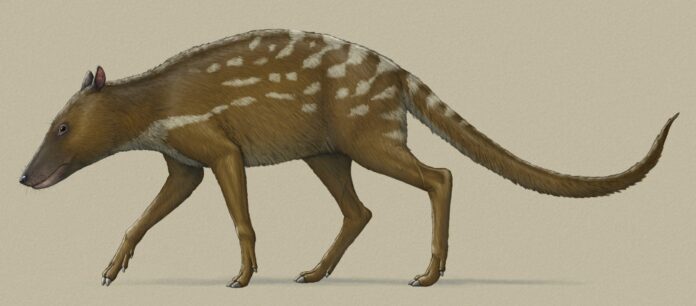
Instead of flippers, a blowhole, and a body the size of a school bus, the ancestor of whales walked on four legs, was covered in fur, and was no larger than a fox. This remarkable transformation is a compelling evolutionary story. Whales, some of the largest animals ever to exist, have ancestors that were much smaller and spent significant time on land.
The extinct animal, called Indohyus, lived in Asia between 49 and 45 million years ago. Its name means "Indian Pig", as it was first found in India’s Jammu and Kashmir region. This mammal belongs to a group known as raoellids, which were semi-aquatic and lived around northern India and Pakistan during the Eocene era.
Indohyus resembled a fox, with a long snout, a slim body, skinny legs, and a long tail. It had thickened bones, similar to those of modern hippos and whales, suggesting a semi-aquatic lifestyle. Research indicates that it may have spent more time underwater than on land.
While thriving on the ancient island that is now India, Indohyus lived along coasts covered in tropical mangrove forests. It likely used its dense bones to sink and walk along riverbeds, possibly to hide from predators or to feed on aquatic plants.
Discovered in 1970 by geologist Ranga Rao, Indohyus was named after India’s first female prime minister, Indira Gandhi. Research later revealed that it is closely related to modern whales.
Indohyus faced extinction roughly 45 million years ago due to a warming climate, leading its descendants to adapt fully to aquatic life. Following Indohyus, larger animals like Pakicetus emerged, marking the evolution of whales into the remarkable creatures we know today.
Test Your Understanding
How much do you know?