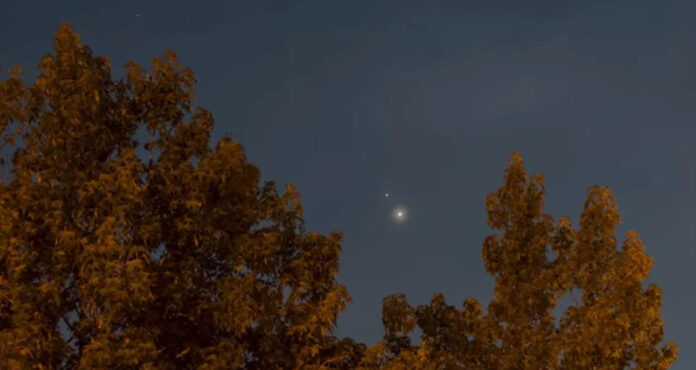
This week, skygazers may have noticed the bright appearances of two planets, Venus and Jupiter, in the night sky. Soon, they will be joined by a third planet, Mercury, transforming this celestial event into a notable planet parade.
Although such alignments are not particularly rare, they stimulate considerable interest among the public. While at least one planet is typically visible to the naked eye from Earth, witnessing multiple planets in alignment is a relatively uncommon occurrence that captivates many stargazers.
The planet parade will feature a meeting of Mercury, Venus, and Jupiter. This event is expected to be visible from Thursday, June 11, through Monday, June 15, according to NASA’s monthly skywatching guide. On these nights, observers will have the chance to see Venus, one of the brightest celestial bodies after the sun, alongside Jupiter, the largest planet in the solar system. However, the appearance of Mercury, which orbits the sun in just 88 days, marks a special highlight because it is less frequently seen from Earth.
The term “planet parade” is not an official astronomical designation, but rather a casual reference used by astronomers and enthusiasts to describe specific celestial events when planets align along an imaginary line called the ecliptic. While planetary alignments occur without much fanfare, having the opportunity to observe several planets at once is noteworthy.
Currently, Mercury joins Venus and Jupiter after the latter two have been in conjunction since June 9. During a conjunction, at least two planets appear close in the sky from our perspective, even if they are millions of miles apart.
For those in the Northern Hemisphere, observing the planet parade should be straightforward. Looking west after sunset will reveal all three planets. To enhance the viewing experience, it is advisable to find a location with minimal light interference and unobstructed views toward the horizon. No optical instruments are required to spot these planets, although telescopes can improve the experience.
Test Your Understanding
How much do you know?