Solar activity reached moderate levels on 30 July when Region 4492 produced a long-duration M1.9 solar flare at 17:00 UTC. This was accompanied by an eruption of a filament, located near N20W67, that extended about eight degrees in length.
Two Type II radio sweeps were recorded during this period. The first occurred at 16:27 UTC, moving at an estimated speed of 853 km/s, followed by a second sweep at 16:45 UTC, which reached 1,681 km/s. Other notable radio events included a Type IV sweep at 16:31 UTC, and a Tenflare that lasted 17 minutes, peaking at 16:43 UTC with a measurement of 190 solar flux units (sfu).
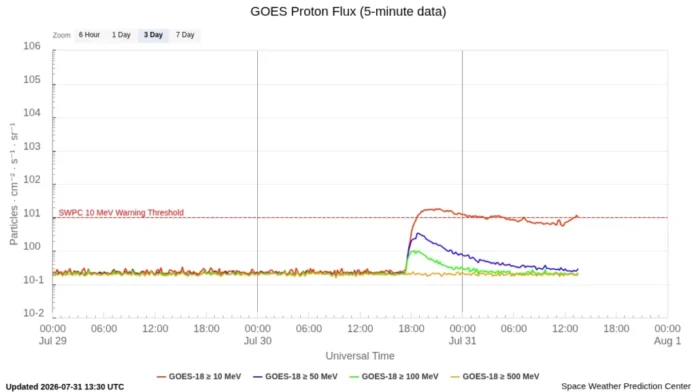
The greater-than-10 MeV proton flux crossed the S1 threshold, indicating a minor solar radiation storm, at 18:45 UTC on 30 July, peaking at 18 particle flux units (pfu) by 20:55 UTC. It fell below this threshold by 00:30 UTC on 31 July but exceeded it again later that day.
The Solar Weather Prediction Centre (SWPC) noted that these proton enhancements likely stemmed from the M1.9 flare. They predicted a continued possibility of S1 conditions on 31 July and 1 August, while the greater-than-2 MeV electron flux was expected to remain at normal to moderate levels through 2 August.
Imagery from the GOES coronagraph started showing a partial-halo coronal mass ejection (CME) from 17:15 UTC. Forecasts suggested this CME could reach Earth early on 2 August.
The SWPC reported that solar wind parameters remained stable leading up to 12:30 UTC on 31 July. With expected disturbances in solar wind conditions, some geomagnetic activity is anticipated, particularly from the CME’s arrival on 2 August. These storms may disrupt high-latitude power systems and visibility of auroras could extend to regions as far south as New York and Idaho. Solar activity is expected to remain low, with some risk of minor radio blackouts.