Friday, June 5, 2026

Northern Lights Alert Upgraded for 23 US States

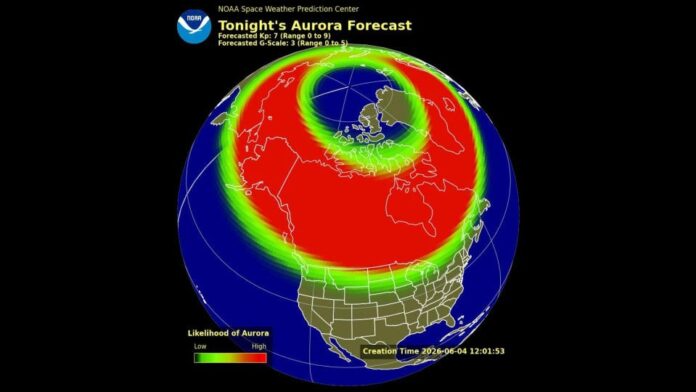
The National Oceanic and Atmospheric Administration (NOAA) has significantly revised its forecast for an upcoming northern lights display, warning of strong to severe geomagnetic storms on Thursday, June 4, and continuing into Friday, June 5. These storms will result from multiple coronal mass ejections (CMEs), which are immense clouds of heated gas and magnetic fields expelled from the sun following solar flares, colliding with Earth’s magnetic field.

Skywatchers in the northern United States are encouraged to observe the northern sky after dark, weather permitting. A waning gibbous moon, illuminated at 82%, will rise in the east post-midnight and could obscure the view of the aurora by brightening the night sky.

Initial predictions indicated that the strongest aurora activity would primarily occur on Friday. However, NOAA’s current outlook raises the possibility of G2 (Moderate) and G3 (Strong) geomagnetic storms affecting North America on Thursday afternoon and evening, with isolated G4 (Severe) storms possible during the peak of the event overnight.

The advanced forecast comes after multiple Earth-directed CMEs were detected on June 3 and 4. When these CMEs travel closely in succession, they can interact and enhance one another, a phenomenon referred to as a “cannibal CME.” NOAA’s three-day prediction anticipates Kp values reaching 6.33 (G2) from 15:00 to 18:00 UTC and increasing to 6.67 (G3) between 18:00 and 21:00 UTC, aligning with evening hours in North America.

A G3 storm may illuminate the northern lights across broad regions, while isolated G4 conditions could extend visibility further south. Key states for potential viewing include Washington, Idaho, Montana, and others, with additional possibilities in states further south where skies are clear. Observers are advised to follow real-time space weather updates, as the auroral intensity will depend on the solar wind’s magnetic field orientation.

Test Your Understanding

Start Quiz

Vocabulary List:
6 words · tap to reveal
ON

Accent

geomagnetic/ˌdʒioʊməˈɡnɛtɪk/adjective
about changes in Earth's magnetic field

ejections/ɪˈdʒɛkʃənz/noun
large amounts of gas pushed out from the sun

waning/ˈweɪnɪŋ/adjective
becoming less bright or smaller over time

obscure/əbˈskjʊr/verb
make something hard to see or understand

phenomenon/fəˈnɑmənən/noun
an event or thing that can be seen or studied

orientation/ˌɔriənˈteɪʃən/noun
the direction or position of something in space

How much do you know?

What date is the northern lights display forecast for?
June 3
June 4
June 5
June 6
What is the maximum Kp value predicted during the geomagnetic storms?
5.33
6.33
7.33
8.33
What phase of the moon will be present during the northern lights display?
New moon
Full moon
Waning gibbous
Waxing crescent
Which states are mentioned as key for potential viewing of the northern lights?
California, Texas, and New York
Florida, Ohio, and Georgia
Washington, Idaho, and Montana
Arizona, Nevada, and Utah
What classification of storms might affect North America on Thursday?
G1 and G2
G2 and G3
G3 and G4
G4 and G5
What phenomenon occurs when multiple CMEs interact with one another?
Auroral storm
Solar flare
Cannibal CME
Geomagnetic reversal
The northern lights display is expected to occur on June 6.
NOAA predicts strong geomagnetic storms on Friday, June 5.
The Kp value is predicted to reach 6.67 during the peak of the event.
A full moon will enhance the visibility of the aurora.
Observers should check real-time space weather updates for auroral intensity.
G4 storms are unlikely during the upcoming event.
The northern lights display will begin on June 4 and continue into .
The storms result from multiple mass ejections from the sun.
Skywatchers can observe the northern sky after .
A gibbous moon will rise post-midnight.
NOAA's current outlook raises the possibility of G2 and G3 storms.
Observers are advised to follow real-time space weather .
This question is required

Test Your Understanding

Start Quiz
Vocabulary List:
6 words · tap to reveal
ON
Accent
geomagnetic/ˌdʒioʊməˈɡnɛtɪk/adjective
about changes in Earth's magnetic field
ejections/ɪˈdʒɛkʃənz/noun
large amounts of gas pushed out from the sun
waning/ˈweɪnɪŋ/adjective
becoming less bright or smaller over time
obscure/əbˈskjʊr/verb
make something hard to see or understand
phenomenon/fəˈnɑmənən/noun
an event or thing that can be seen or studied
orientation/ˌɔriənˈteɪʃən/noun
the direction or position of something in space

How much do you know?

What date is the northern lights display forecast for?
June 3
June 4
June 5
June 6
What is the maximum Kp value predicted during the geomagnetic storms?
5.33
6.33
7.33
8.33
What phase of the moon will be present during the northern lights display?
New moon
Full moon
Waning gibbous
Waxing crescent
Which states are mentioned as key for potential viewing of the northern lights?
California, Texas, and New York
Florida, Ohio, and Georgia
Washington, Idaho, and Montana
Arizona, Nevada, and Utah
What classification of storms might affect North America on Thursday?
G1 and G2
G2 and G3
G3 and G4
G4 and G5
What phenomenon occurs when multiple CMEs interact with one another?
Auroral storm
Solar flare
Cannibal CME
Geomagnetic reversal
The northern lights display is expected to occur on June 6.
NOAA predicts strong geomagnetic storms on Friday, June 5.
The Kp value is predicted to reach 6.67 during the peak of the event.
A full moon will enhance the visibility of the aurora.
Observers should check real-time space weather updates for auroral intensity.
G4 storms are unlikely during the upcoming event.
The northern lights display will begin on June 4 and continue into .
The storms result from multiple mass ejections from the sun.
Skywatchers can observe the northern sky after .
A gibbous moon will rise post-midnight.
NOAA's current outlook raises the possibility of G2 and G3 storms.
Observers are advised to follow real-time space weather .
This question is required

Read More