Sunday, June 7, 2026

US Debt Hits Limit Before Interest Payments Risk Crisis

Soaring U.S. debt and forecasts suggesting even higher levels in the near future have sparked growing concern about potential financial instability. The Penn Wharton Budget Model (PWBM) indicates that a debt level exceeding 210% of GDP could be a tipping point.

This threshold represents the “outer bound” for federal debt. Above this level, it may become impossible to meet interest payments on U.S. debt through feasible taxes on income. PWBM warns that exceeding this figure could lead to defaults on Treasury debts and social benefits like Social Security.

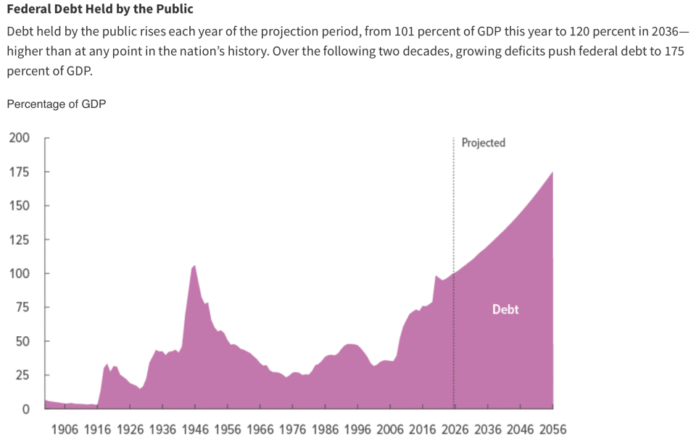
Currently, the debt-to-GDP ratio is around 100%, and predictions from the Congressional Budget Office estimate it could reach 175% by 2056. However, increasing healthcare costs and Medicare spending could push this limit to be reached much sooner, potentially within 14 years under historical healthcare growth rates.

The PWBM report suggests that addressing federal finances effectively would require a significant, permanent tax increase of about 15 percentage points on all labour income. This would eliminate income caps that currently protect higher earnings. Rising debt could lead to negative economic effects, including weaker wages and slower growth.

Yet, two key assumptions underpin these projections. First, if financial markets become unstable, a sudden market crash could push debt holders to demand higher yields, increasing overall debt costs. Second, confidence in Congress and the White House restoring fiscal health must remain stable; any loss of belief could shorten timelines for necessary reform.

While some point to Japan’s high debt levels as a counter-argument, the U.S. has unique financial advantages, including the global reserve currency status of the dollar. However, changes in international investment trends could complicate these factors. Current bond yields are rising, suggesting potential changes in funding patterns, particularly as the insolvency of Social Security and Medicare trust funds approaches in 2034. This could pressure lawmakers to act on reforms.

Test Your Understanding

Start Quiz

Vocabulary List:
6 words · tap to reveal
ON

Accent

soaring/ˈsɔrɪŋ/adjective
rising quickly to a much higher level

instability/ˌɪnstəˈbɪləti/noun
when things are likely to change or fail

threshold/ˈθrɛʃhoʊld/noun
a level or point where something changes

feasible/ˈfizəbl/adjective
possible and able to be done

defaults/dɪˈfɔlts/noun
failures to pay money that is owed

yields/jildz/noun
how much money someone earns from an investment

How much do you know?

What is the debt level that the Penn Wharton Budget Model indicates could be a tipping point?
175%
210%
100%
150%
According to the Congressional Budget Office, what is the predicted debt-to-GDP ratio by 2056?
150%
175%
200%
225%
What percentage point increase in labor income tax is suggested by PWBM to address federal finances?
5
10
15
20
By what year are Social Security and Medicare trust funds expected to become insolvent?
2025
2030
2034
2040
What could happen if debt levels exceed 210% of GDP?
Stronger economic growth
Defaults on Treasury debts
Increased confidence in Congress
Lower healthcare costs
What role does the U.S. dollar play in its financial advantages?
It is the global reserve currency
It has a fixed exchange rate
It is backed by gold
It is less volatile than other currencies
A debt-to-GDP ratio of around 100% is currently observed in the U.S.
The PWBM report suggests that no tax increase is needed to address federal finances.
Rising healthcare costs are predicted to delay the approach to the 175% debt-to-GDP ratio.
Market instability could lead to higher yields demanded by debt holders.
Confidence in fiscal health restoration must remain stable for the projections to hold.
Japan's debt levels serve as a valid comparison due to the same financial environment as the U.S.
The Penn Wharton Budget Model indicates a debt level exceeding 210% of GDP could be a tipping point. This threshold represents the outer bound for federal debt to meet interest payments on U.S. debt through feasible taxes on income. Therefore, exceeding this figure could lead to defaults on .
The Congressional Budget Office predicts the debt-to-GDP ratio could reach 175% by .
To address federal finances effectively, a significant tax increase of about 15 percentage points on all labour income is suggested. This includes eliminating income caps for .
Current bond yields are rising, which may change funding patterns, especially with the of Social Security and Medicare trust funds approaching in 2034.
If confidence in Congress and the White House wanes, it could shorten the timelines for necessary .
The U.S. has unique financial advantages, one of which is its status as the currency.
This question is required

Test Your Understanding

Start Quiz
Vocabulary List:
6 words · tap to reveal
ON
Accent
soaring/ˈsɔrɪŋ/adjective
rising quickly to a much higher level
instability/ˌɪnstəˈbɪləti/noun
when things are likely to change or fail
threshold/ˈθrɛʃhoʊld/noun
a level or point where something changes
feasible/ˈfizəbl/adjective
possible and able to be done
defaults/dɪˈfɔlts/noun
failures to pay money that is owed
yields/jildz/noun
how much money someone earns from an investment

How much do you know?

What is the debt level that the Penn Wharton Budget Model indicates could be a tipping point?
175%
210%
100%
150%
According to the Congressional Budget Office, what is the predicted debt-to-GDP ratio by 2056?
150%
175%
200%
225%
What percentage point increase in labor income tax is suggested by PWBM to address federal finances?
5
10
15
20
By what year are Social Security and Medicare trust funds expected to become insolvent?
2025
2030
2034
2040
What could happen if debt levels exceed 210% of GDP?
Stronger economic growth
Defaults on Treasury debts
Increased confidence in Congress
Lower healthcare costs
What role does the U.S. dollar play in its financial advantages?
It is the global reserve currency
It has a fixed exchange rate
It is backed by gold
It is less volatile than other currencies
A debt-to-GDP ratio of around 100% is currently observed in the U.S.
The PWBM report suggests that no tax increase is needed to address federal finances.
Rising healthcare costs are predicted to delay the approach to the 175% debt-to-GDP ratio.
Market instability could lead to higher yields demanded by debt holders.
Confidence in fiscal health restoration must remain stable for the projections to hold.
Japan's debt levels serve as a valid comparison due to the same financial environment as the U.S.
The Penn Wharton Budget Model indicates a debt level exceeding 210% of GDP could be a tipping point. This threshold represents the outer bound for federal debt to meet interest payments on U.S. debt through feasible taxes on income. Therefore, exceeding this figure could lead to defaults on .
The Congressional Budget Office predicts the debt-to-GDP ratio could reach 175% by .
To address federal finances effectively, a significant tax increase of about 15 percentage points on all labour income is suggested. This includes eliminating income caps for .
Current bond yields are rising, which may change funding patterns, especially with the of Social Security and Medicare trust funds approaching in 2034.
If confidence in Congress and the White House wanes, it could shorten the timelines for necessary .
The U.S. has unique financial advantages, one of which is its status as the currency.
This question is required

Read More