Thursday, April 23, 2026

US Debt Demand Slumps Amid $10 Trillion Roll-Over

President Donald Trump’s military actions in Iran are affecting U.S. debt investors, as interest in Treasury securities declines. The demand for two-, five-, and seven-year Treasury notes fell last week, resulting in higher yields than expected. This is a significant change from a month ago when the Treasury auction saw record demand for 30-year bonds.

The short end of the yield curve is facing pressure due to rising oil prices, which are driving inflation expectations. This situation has caused the Federal Reserve to pause further rate cuts, with interest rate hike predictions increasing. Additionally, the financial cost of the U.S. involvement in Iran is straining the national debt, with reports that the Pentagon seeks $200 billion from Congress. Notably, military operations have depleted expensive munitions and damaged U.S. military assets.

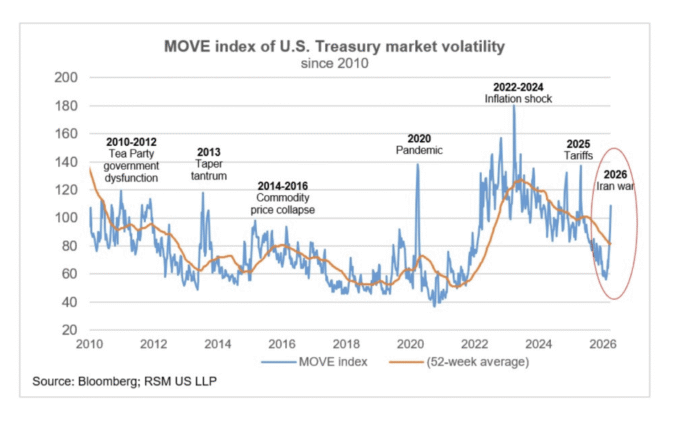
Joseph Brusuelas, Chief Economist at RSM, noted that the Treasury bond market is reacting to the conflict’s economic impact, leading to increased market volatility and a higher risk associated with buying Treasuries. This week, the two-year yield exceeded 4.0%, while the ten-year yield surpassed 4.4%.

The “MOVE index,” which measures volatility in the Treasury market, has significantly risen, indicating potential instability. If the current uncertainty persists, it may lead to broader stress in debt markets.

As the conflict continues, analysts predict it could last months, affecting borrowing costs. The federal government is also expected to refinance $10 trillion of debt due in the next year, alongside a budget deficit projected to reach $2 trillion. Increased corporate debt may further complicate the borrowing landscape, according to experts.

Test Your Understanding

Start Quiz

Vocabulary List:
6 words · tap to reveal
ON

Accent

Treasury/ˈtrɛʒəri/noun
a government's department that manages money

yield/jiːld/noun
how much profit comes from an investment

auction/ˈɔkʃən/noun
a public sale where people bid money

volatility/ˌvɑləˈtɪlɪti/noun
frequent and large changes in prices

refinance/ˌriːˈfaɪnæns/verb
to change a loan to get better terms

munitions/mjuːˈnɪʃənz/noun
weapons, bombs, and related military supplies

How much do you know?

What has happened to the demand for Treasury securities recently?
It has increased
It has declined
It has remained unchanged
It has doubled
What caused the Federal Reserve to pause further rate cuts?
Rising oil prices
Decreasing inflation
Increase in stock prices
Stable yield curve
How much funding is the Pentagon seeking from Congress?
$100 billion
$150 billion
$200 billion
$250 billion
What is the projected budget deficit for the federal government?
$1 trillion
$2 trillion
$3 trillion
$4 trillion
What is the current yield of the two-year Treasury note mentioned in the text?
3.5%
4.0%
4.2%
4.4%
Which index measures volatility in the Treasury market?
VIX index
MOVE index
SPX index
TRIX index
Interest in Treasury securities is currently increasing.
The Treasury auction recently saw record demand for 30-year bonds.
The yield curve is currently experiencing pressure from rising oil prices.
Joseph Brusuelas is the Chief Economist at RSM.
Current uncertainty in the market does not affect U.S. debt investors.
The financial cost of U.S. involvement in Iran is reducing the national debt.
The demand for two-, five-, and seven-year Treasury notes fell last week, resulting in higher yields than expected. This is a significant change from a month ago when the Treasury auction saw record demand for 30-year bonds. The short end of the yield curve is facing pressure due to rising oil prices, which are driving expectations.
The Pentagon seeks $200 billion from Congress to cover the financial cost of U.S. in Iran.
According to Joseph Brusuelas, the Treasury bond market is reacting to the economic impact of the .
If the current uncertainty persists, it may lead to broader stress in markets.
The federal government is expected to refinance $10 trillion of debt due in the next .
Analysts predict the conflict could last , affecting borrowing costs.
This question is required

Test Your Understanding

Start Quiz
Vocabulary List:
6 words · tap to reveal
ON
Accent
Treasury/ˈtrɛʒəri/noun
a government's department that manages money
yield/jiːld/noun
how much profit comes from an investment
auction/ˈɔkʃən/noun
a public sale where people bid money
volatility/ˌvɑləˈtɪlɪti/noun
frequent and large changes in prices
refinance/ˌriːˈfaɪnæns/verb
to change a loan to get better terms
munitions/mjuːˈnɪʃənz/noun
weapons, bombs, and related military supplies

How much do you know?

What has happened to the demand for Treasury securities recently?
It has increased
It has declined
It has remained unchanged
It has doubled
What caused the Federal Reserve to pause further rate cuts?
Rising oil prices
Decreasing inflation
Increase in stock prices
Stable yield curve
How much funding is the Pentagon seeking from Congress?
$100 billion
$150 billion
$200 billion
$250 billion
What is the projected budget deficit for the federal government?
$1 trillion
$2 trillion
$3 trillion
$4 trillion
What is the current yield of the two-year Treasury note mentioned in the text?
3.5%
4.0%
4.2%
4.4%
Which index measures volatility in the Treasury market?
VIX index
MOVE index
SPX index
TRIX index
Interest in Treasury securities is currently increasing.
The Treasury auction recently saw record demand for 30-year bonds.
The yield curve is currently experiencing pressure from rising oil prices.
Joseph Brusuelas is the Chief Economist at RSM.
Current uncertainty in the market does not affect U.S. debt investors.
The financial cost of U.S. involvement in Iran is reducing the national debt.
The demand for two-, five-, and seven-year Treasury notes fell last week, resulting in higher yields than expected. This is a significant change from a month ago when the Treasury auction saw record demand for 30-year bonds. The short end of the yield curve is facing pressure due to rising oil prices, which are driving expectations.
The Pentagon seeks $200 billion from Congress to cover the financial cost of U.S. in Iran.
According to Joseph Brusuelas, the Treasury bond market is reacting to the economic impact of the .
If the current uncertainty persists, it may lead to broader stress in markets.
The federal government is expected to refinance $10 trillion of debt due in the next .
Analysts predict the conflict could last , affecting borrowing costs.
This question is required

Read More